
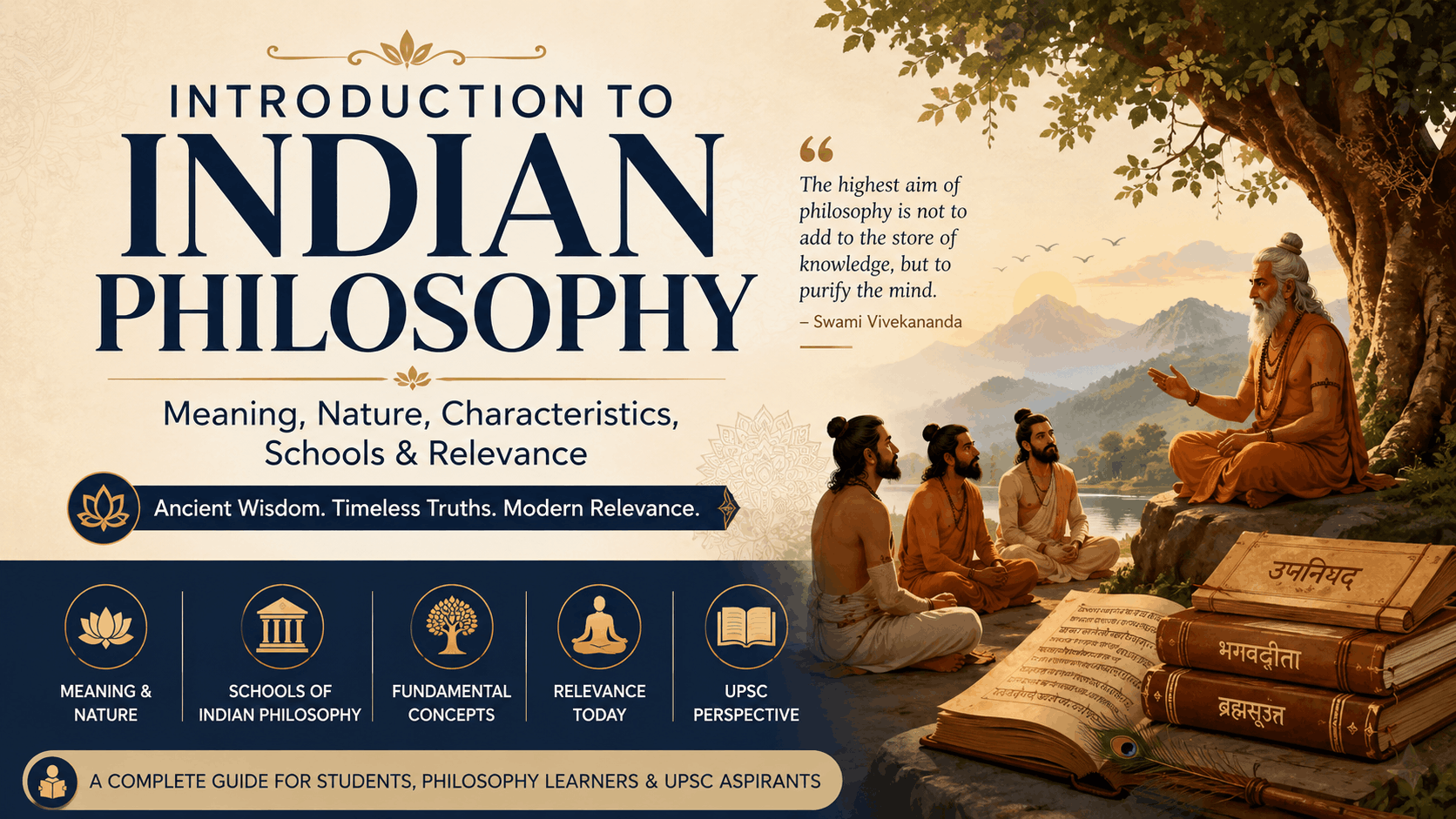
Human beings have always tried to understand life and its deeper meaning. Questions like Who am I?, Why do I exist?, and What is the purpose of life? have inspired people to think beyond everyday experiences. This search for truth gave rise to philosophy.
Indian Philosophy begins with a tradition that is both ancient and practical. It did not develop only to satisfy curiosity, but to help people understand life and find a path toward peace and wisdom. The roots of such philosophy can be traced to the Vedas and later to the Upanishads. Over time, many thinkers and schools developed different ideas about reality, knowledge, and human existence.
One important difference between Indian and Western philosophy is their main focus. Western philosophy often gives more importance to logical analysis and understanding the external world. Indian philosophy, on the other hand, places strong emphasis on inner experience and self-realization. It is not simply a collection of theories. It is a way of life that connects knowledge with action.
It seeks answers to important questions:
- What is reality?
- What is the true nature of the self?
- Why does suffering exist?
- How can human beings achieve happiness and freedom?
The goal of Indian philosophy is not only to think deeply but also to improve human life.
What is Indian Philosophy?
Indian philosophy refers to the study of reality, knowledge, values, and human life developed in the Indian tradition. It is commonly known by the Sanskrit term Darshana. The word Darshana comes from the Sanskrit root Drish, which means:
“to see” or “to gain insight.”
In this sense, philosophy is not just about collecting information. It is about understanding truth through knowledge and experience. It mainly aims to:
Discover Truth
Indian thinkers wanted to understand the ultimate nature of reality.
Remove Ignorance
Ignorance is considered the main cause of suffering and confusion.
Attain Liberation (Moksha)
Many Indian philosophical schools believe that the highest goal of life is liberation from suffering and the cycle of birth and death.
Promote Ethical Living
Indian philosophy teaches values such as honesty, compassion, and self-control.
Achieve Self-Realization
Understanding one’s true self is considered one of the highest forms of knowledge.
Nature and Characteristics of Indian Philosophy
Indian philosophy has several unique features that make it different from other traditions.
1. Spiritual Orientation
Indian philosophy has a strong spiritual foundation.
It tries to understand deeper truths about life and human existence instead of focusing only on material things.
2. Practical Approach
Indian philosophy is closely connected with daily life.
Its ideas are meant to guide human behavior and help people live better lives.
Philosophy is not simply theory; it is also practice.
3. Importance of Moksha
Most Indian philosophical schools consider Moksha, or liberation, as the highest goal of life.
Moksha means freedom from:
- Suffering
- Ignorance
- Bondage
- The cycle of birth and rebirth
4. Doctrine of Karma
The principle of Karma plays a major role in Indian thought.
According to this idea: Every action has consequences.
Good actions lead to positive outcomes, while harmful actions produce negative effects.
5. Importance of Ethics
Indian philosophy gives great importance to moral values.
Important values include:
- Truth
- Non-violence
- Compassion
- Discipline
- Honesty
Knowledge without ethical behavior is considered incomplete.
6. Self-Realization
Indian philosophy teaches that many human problems arise because people do not understand their true nature. The purpose of self-realization is to discover who we really are.
7. Connection Between Theory and Practice
A special feature of Indian philosophy is that ideas are connected with practice.
Knowledge is supported through:
- Meditation
- Self-discipline
- Good conduct
- Personal experience
Indian philosophy therefore combines: Knowledge + Practice + Experience instead of treating philosophy only as an intellectual subject.
Historical Development of Indian Philosophy
Indian philosophy developed over a long period of time. It evolved through different stages, and each stage added new ideas and perspectives. From the Vedic age to modern thinkers, it continued to grow while keeping its central aim of understanding truth and human life.
1. Vedic Period
The Vedic period is considered the earliest stage of Indian philosophy. The ideas of this period are found in the Vedas, which are among the oldest texts of Indian civilization. Initially, the focus was mainly on prayers, rituals, and worship of natural forces.
Important features of the Vedic period:
- Importance of rituals and sacrifices
- Faith in cosmic order (Rta)
- Worship of natural powers
- Search for harmony between humans and nature
Although ritual practices were important, people gradually began asking deeper questions about existence and reality.
2. Upanishadic or Vedantic Period
The Upanishads marked an important turning point in Indian philosophy. Thinkers moved from external rituals to inner understanding and spiritual knowledge.
Major ideas of the Upanishadic period:
- Search for ultimate reality
- Discussion of the self (Atman)
- Concept of Brahman as supreme reality
- Importance of knowledge and self-realization
The Upanishads teach that true knowledge removes ignorance and leads to liberation.
3. Classical Period
The classical period witnessed the rise of systematic philosophical schools. During this period, philosophers developed organized systems with clear arguments and methods.
Major schools included:
- Nyaya
- Vaisheshika
- Samkhya
- Yoga
- Mimamsa
- Vedanta
- Buddhism
- Jainism
- Charvaka
This period created the foundation of Indian philosophical thought.
4. Medieval Period
The medieval period saw the growth of devotional movements and new interpretations of philosophical ideas.
Important developments included:
- Growth of Bhakti traditions
- Development of different forms of Vedanta
- Emphasis on devotion and spiritual experience
- Interaction between philosophy and religion
Thinkers during this period tried to make philosophy easier for ordinary people.
5. Modern Period
Modern Indian philosophy emerged through interaction with Western ideas and changing social conditions. Modern thinkers attempted to connect ancient wisdom with contemporary problems.
Major themes included:
- Humanism
- Social reform
- Nationalism
- Religious harmony
- Practical spirituality
Important modern thinkers include:
- Swami Vivekananda
- Sri Aurobindo
- Sarvepalli Radhakrishnan
- Mahatma Gandhi
These thinkers presented Indian philosophy in a modern and global context.
Classification of Schools of Indian Philosophy
Indian philosophical systems are generally divided into two groups:
- Astika (Orthodox) Schools
- Nastika (Heterodox) Schools
The basis of classification is acceptance or rejection of the authority of the Vedas.
| Orthodox (Astika) | Heterodox (Nastika) |
|---|---|
| Nyaya | Buddhism |
| Vaisheshika | Jainism |
| Samkhya | Charvaka |
| Yoga | |
| Mimamsa | |
| Vedanta |
Orthodox (Astika) Schools
1. Nyaya
Nyaya mainly deals with logic and reasoning.
Important ideas:
- Importance of valid knowledge
- Use of logical arguments
- Study of methods of proof
Nyaya teaches that correct knowledge leads to freedom from suffering.
2. Vaisheshika
Vaisheshika studies the nature of reality and matter.
Important ideas:
- Reality consists of basic elements
- Classification of objects and qualities
- Atomic theory of matter
It attempts to explain the physical world through logical analysis.
3. Samkhya
Samkhya is one of the oldest philosophical systems.
Important ideas:
- Dualism of Purusha and Prakriti
- Purusha represents consciousness
- Prakriti represents matter
Liberation occurs when a person understands the difference between these two realities.
4. Yoga
Yoga philosophy is closely connected with Samkhya philosophy.
Important ideas:
- Control of mind and body
- Meditation and discipline
- Eight-fold path (Ashtanga Yoga)
Yoga aims at achieving mental peace and self-realization.
5. Mimamsa
Mimamsa emphasizes rituals and duties.
Important ideas:
- Importance of Vedic authority
- Performance of duties
- Ethical action
It gives importance to right conduct and religious practice.
6. Vedanta
Vedanta developed mainly from the teachings of the Upanishads.
Important ideas:
- Nature of Brahman
- Relationship between self and reality
- Liberation through knowledge
Vedanta later developed into different branches such as:
- Advaita Vedanta
- Vishishtadvaita
- Dvaita
Heterodox (Nastika) Schools
1. Buddhism
Buddhism rejects the authority of the Vedas.
Important ideas:
- Four Noble Truths
- Middle Path
- Impermanence
- Freedom from suffering
Its main focus is ending suffering through wisdom and discipline.
2. Jainism
Jain philosophy gives great importance to non-violence.
Important ideas:
- Ahimsa (non-violence)
- Multiple viewpoints (Anekantavada)
- Self-discipline
Jainism teaches that liberation comes through right knowledge and right conduct.
3. Charvaka
Charvaka represents a materialistic approach.
Important ideas:
- Acceptance of direct perception only
- Rejection of life after death
- Focus on material reality
Charvaka differs greatly from other Indian philosophical systems.
Fundamental Concepts in Indian Philosophy
Several concepts form the foundation of Indian thought.
1. Atman
Atman means the individual self or soul. Many schools believe that understanding the true nature of the self is necessary for liberation.
2. Brahman
Brahman refers to the ultimate reality or supreme principle of the universe. In Vedanta philosophy, Brahman is considered the source of everything.
3. Karma
Karma means action and its consequences. According to this principle, Every action creates effects that influence future experiences.
4. Dharma
Dharma refers to duty, righteousness, and moral responsibility. It guides human behavior and social order.
5. Moksha
Moksha means liberation from suffering and the cycle of birth and death. Most Indian philosophical schools consider it the highest goal of life.
6. Rebirth
Many Indian traditions accept the idea of rebirth. According to this belief, the soul takes different forms until liberation is achieved.
Relevance of Indian Philosophy Today
Many people think philosophy belongs only to ancient times. However, Indian philosophy continues to remain meaningful in modern life. Its ideas can help people deal with stress, ethical challenges, social problems, and personal growth.
1. Psychological Well-Being
Modern life often brings stress, anxiety, and mental pressure.
Indian philosophy offers practices that help develop inner balance and peace.
Examples include:
- Meditation
- Self-discipline
- Mindfulness
- Yoga practices
These ideas encourage people to understand their thoughts and emotions better.
2. Ethics and Moral Values
Today, societies face many ethical challenges such as corruption, violence, and intolerance.
Indian philosophy promotes values like:
- Truth
- Compassion
- Non-violence
- Honesty
- Responsibility
These values can help create a more ethical society.
3. Social Harmony
Indian thought emphasizes respect for all living beings and peaceful coexistence.
Ideas such as tolerance and unity encourage people to live together despite differences in beliefs and cultures.
4. Environmental Awareness
Many Indian traditions see nature as sacred and interconnected with human life.
This perspective teaches:
- Respect for nature
- Responsible use of resources
- Harmony between humans and the environment
Such ideas are highly relevant in a world facing environmental problems.
5. Personal Development
Indian philosophy encourages individuals to understand themselves and improve their character.
It teaches:
- Self-control
- Discipline
- Positive thinking
- Continuous learning
These qualities support long-term personal growth.
Indian Philosophy vs Western Philosophy
Although both traditions seek knowledge and truth, their approaches often differ.
| Basis | Indian Philosophy | Western Philosophy |
|---|---|---|
| Main Aim | Liberation and self-realization | Knowledge and rational understanding |
| Focus | Inner experience | External world and logical analysis |
| Nature | Spiritual and practical | Analytical and theoretical |
| Method | Meditation, experience, intuition, reasoning | Logic and scientific reasoning |
| Goal | Freedom from suffering | Understanding reality and knowledge |
| Relation to Life | Closely connected with daily life | Often more academic in approach |
These differences are general observations. Both traditions have diverse schools and ideas.
UPSC Perspective
For UPSC Philosophy Optional students, Indian philosophy forms an important section of the syllabus. Questions are often asked from major schools, concepts, and comparisons.
Important Themes for Philosophy Optional
Focus on the following areas:
Schools of Indian Philosophy
- Nyaya
- Vaisheshika
- Samkhya
- Yoga
- Mimamsa
- Vedanta
- Buddhism
- Jainism
- Charvaka
Important Concepts
- Atman
- Brahman
- Karma
- Dharma
- Moksha
- Rebirth
- Liberation
- Self-realization
Frequently Asked Areas
UPSC generally focuses on:
- Theory of knowledge
- Nature of self
- Reality and existence
- Liberation
- Ethical concepts
- Comparative philosophy
Previous-Year Question Trends
Some common question patterns include:
Short-answer questions
- Explain the meaning of Moksha.
- Distinguish between Astika and Nastika schools.
- Explain the concept of Karma.
Long-answer questions
- Discuss the nature and characteristics of Indian philosophy.
- Explain the relation between Atman and Brahman.
- Compare Indian and Western philosophical traditions.
- Explain the contribution of major schools of Indian philosophy.
Quick UPSC Revision Points
✔ Indian philosophy is known as Darshana
✔ Darshana means vision or insight
✔ Main goal: Moksha
✔ Karma explains the relation between actions and consequences
✔ Schools are divided into Astika and Nastika
✔ Theory and practice are closely connected
✔ Ethics and spirituality play important roles
Frequently Asked Questions (FAQ)
What is Indian philosophy?
Indian philosophy is a system of thought that studies reality, knowledge, ethics, and human life with the aim of understanding truth and achieving liberation.
What does Darshana mean?
Darshana is a Sanskrit term meaning “vision,” “insight,” or “way of seeing truth.”
What is the main goal of Indian philosophy?
The main goal of Indian philosophy is Moksha or liberation from suffering and the cycle of birth and death.
What are the six orthodox schools of Indian philosophy?
The six orthodox schools are:
- Nyaya
- Vaisheshika
- Samkhya
- Yoga
- Mimamsa
- Vedanta
What are heterodox schools?
Heterodox schools reject the authority of the Vedas.
Examples include:
- Buddhism
- Jainism
- Charvaka
What is Karma in Indian philosophy?
Karma refers to the law of action and consequence, according to which every action produces results.
Why is Indian philosophy important today?
Indian philosophy remains relevant because it promotes ethical values, mental well-being, self-understanding, and social harmony.
How is Indian philosophy useful for UPSC?
Indian philosophy is an important part of the UPSC Philosophy Optional syllabus and frequently appears in examination questions.
Suggested Internal Links
- Schools of Indian Philosophy
- Nyaya Philosophy: Meaning and Theory of Knowledge
- Vedanta Philosophy Explained
- UPSC Philosophy Optional Guide
- Difference Between Astika and Nastika Schools
- Major Concepts in Indian Philosophy
Suggested External References
For authoritative reading:
Internet Encyclopedia of Philosophy – Indian Philosophy
Stanford Encyclopedia of Philosophy – Indian Philosophy
Encyclopaedia Britannica – Indian Philosophy
Conclusion
The Introduction to Indian Philosophy reveals a tradition that goes beyond abstract thinking. It is a search for truth, self-understanding, and meaningful living. From the Vedas and Upanishads to classical schools and modern thinkers, Indian philosophy has developed rich ideas about reality and human life.
Its teachings continue to remain relevant because they address questions that every generation faces: Who are we? What is the purpose of life? How can we live wisely?
For students, researchers, and UPSC aspirants, Indian philosophy is not simply a subject to study. It is a way to understand both the world around us and the world within us.