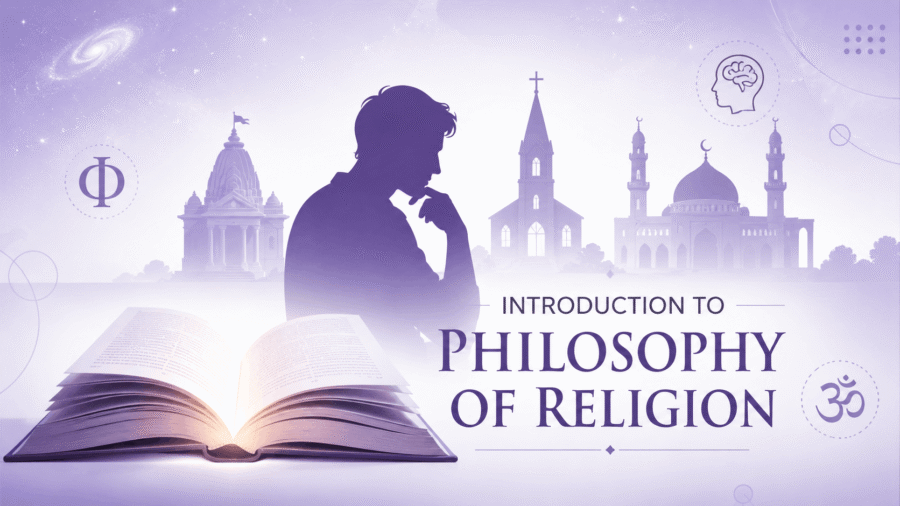
Philosophy begins with wonder. Religion often begins with faith. Philosophy of religion stands at the meeting point of these two human tendencies. It is a branch of philosophy that critically studies religious beliefs, concepts, experiences, and practices through reason and logical analysis.
People throughout history have asked:
- Why are we here?
- Is there a supreme being?
- What happens after death?
- Why do suffering and injustice exist?
Philosophy of religion examines these questions systematically and critically.
Definition
Philosophy of religion may be defined as:
“The philosophical examination of religious beliefs, concepts, practices, and experiences using reason and critical reflection.”
Unlike blind acceptance, it investigates whether religious claims can be justified logically.
For example:
Suppose someone says:
“God created the universe.”
The philosopher of religion asks:
- What does “God” mean?
- What evidence supports this claim?
- Can reason establish it?
- Are there alternative explanations?
- Does God exist?
- Can reason prove God’s existence?
- Why does evil exist?
- Is there life after death?
- What is faith?
- Can religious experiences provide knowledge?
Unlike theology, philosophy of religion does not assume any religious doctrine to be true. Instead, it investigates religion using rational inquiry.
Key Characteristics
It is:
✓ Rational
✓ Analytical
✓ Critical
✓ Reflective
✓ Universal
It attempts to move beyond emotional attachment and examine ideas objectively.
Meaning and Definition of Religion
Religion is one of humanity’s oldest institutions. People pray, worship, meditate, and participate in rituals because they seek meaning and connection with something greater than themselves. Defining religion, however, is difficult. Different scholars emphasize different elements.
Edward Tylor
Religion is:
“Belief in spiritual beings.”
James Martineau
Religion is:
“Belief in an ever-living God.”
Emile Durkheim
Religion consists of:
“Beliefs and practices related to sacred things.”
Essential Elements of Religion
Religion generally includes:
| Elements | Description |
|---|---|
| Belief | Faith in supernatural reality |
| Worship | Prayer and rituals |
| Sacredness | Reverence toward holy things |
| Moral values | Ethical guidance |
| Community | Shared identity |
Example from Daily Life
When someone lights a candle in a temple, church, or mosque, the act is not merely physical.
It symbolizes:
- hope
- devotion
- meaning
- connection with transcendence
Religion often expresses humanity’s search for ultimate reality.
Meaning and Definition of Philosophy
The word philosophy comes from two Greek words:
Philo → Love
Sophia → Wisdom
Thus philosophy literally means:
“Love of wisdom”
Philosophy seeks rational understanding of reality.
Rather than accepting things without questioning, philosophy asks:
- What is truth?
- What is knowledge?
- What is reality?
- What is good life?
Definitions of Philosophy
Plato viewed philosophy as knowledge of eternal truths.
Aristotle described philosophy as the science investigating ultimate causes.
Major Branches of Philosophy
| Branch | Subject |
|---|---|
| Metaphysics | Nature of reality |
| Epistemology | Nature of knowledge |
| Ethics | Morality |
| Logic | Reasoning |
| Aesthetics | Beauty |
Philosophy of religion draws ideas from all these branches.
Related Reading: What is Philosophy? Meaning, Nature and Scope
Relationship Between Philosophy and Religion
Religion and philosophy appear different, yet they share common concerns. Both attempt to answer fundamental questions of existence.
Similarities
Both seek:
- Truth
- Meaning
- Ultimate reality
- Moral guidance
Differences Between Philosophy and Religion
| Philosophy | Religion |
|---|---|
| Based mainly on reason | Based mainly on faith |
| Uses critical inquiry | Uses revelation and belief |
| Questions assumptions | Often accepts sacred teachings |
| Analytical approach | Devotional approach |
| Universal inquiry | Particular traditions |
However, the relationship is complementary rather than hostile. Religion without philosophy may become dogmatic. Philosophy without religion may overlook dimensions of spiritual experience.
Nature, Scope, Major Questions, and Historical Development of Philosophy of Religion
Philosophy of religion is not simply the study of religious rituals or sacred texts. It is a critical and rational investigation into the foundations of religious belief and experience.
It asks not merely “What do people believe?” but also:
- Why do people believe?
- Are these beliefs rational?
- Can they be justified?
- What are their implications?
The discipline therefore occupies an important place between philosophy, theology, psychology, ethics, and social thought.
Nature of Philosophy of Religion
The nature of philosophy of religion can be understood through its key characteristics.
1. Rational and Critical
It uses reason rather than unquestioning acceptance.
For example:
If someone says:
“Miracles prove God’s existence.”
A philosopher asks:
- What exactly is a miracle?
- Can miracles be verified?
- Are there alternative explanations?
Thus, it investigates claims logically.
2. Reflective and Analytical
It reflects deeply upon concepts such as:
- God
- faith
- soul
- evil
- salvation
- freedom
It attempts to clarify meanings and remove confusion.
3. Universal in Approach
Religion often exists within specific traditions, examples being Hinduism, Christianity, Buddhism or Jainism. Philosophy of religion studies questions that apply to all humanity.
Examples:
- Why do humans seek meaning?
- Why do humans believe in something beyond themselves?
4. Interdisciplinary in Nature
It intersects with:
| Discipline | Relationship |
|---|---|
| Psychology | Religious experiences and behavior |
| Sociology | Religion in society |
| Ethics | Moral teachings |
| Metaphysics | Nature of reality |
| Theology | Religious doctrines |
Scope of Philosophy of Religion
The scope of philosophy of religion is broad because religion influences almost every aspect of human life.
Major areas include:
A. Concept of God
Questions include:
- Does God exist?
- What are God’s attributes?
- Is God omnipotent?
- Is God omniscient?
B. Faith and Reason
It studies whether faith can coexist with rational thinking.
C. Religious Experience
Questions include:
- Can mystical experiences reveal truth?
- Are religious experiences objective or subjective?
D. Problem of Evil
One of the oldest philosophical questions:
If God is all-powerful and perfectly good, why does suffering exist?
E. Soul and Immortality
Questions include:
- Does the soul survive death?
- Is there life after death?
F. Religion and Morality
Important questions include:
- Does morality depend on religion?
- Can people be moral without religious belief?
Main Questions in Philosophy of Religion
Throughout history, several fundamental questions have shaped philosophical discussions.
1. Does God Exist?
This is perhaps the most important question in philosophy of religion.
Many arguments have attempted to prove or disprove God’s existence.
Major arguments include:
Cosmological Argument
Everything has a cause.
Since the universe exists, there must be a first cause, identified as God.
Teleological Argument
The universe appears ordered and purposeful.
Complex design suggests an intelligent designer.
Example:
A watch suggests a watchmaker.
Similarly, the universe may suggest a creator.
Ontological Argument
This argument attempts to prove God’s existence through pure reason.
It claims that the greatest conceivable being must necessarily exist.
Criticisms
Philosophers have raised objections:
- Natural processes may explain order.
- Existence may not be a property.
- Infinite regress raises difficulties.
Further Reading: Arguments for the Existence of God
2. Can God Be Known Through Reason?
A major debate concerns whether reason alone can establish religious truths.
Two approaches emerged:
Rationalism
Knowledge of God can emerge through logical reasoning.
Supporters include:
- Thomas Aquinas
- René Descartes
Fideism
Faith rather than reason is central.
Religious truth may exceed human logic.
Supporters include:
- Søren Kierkegaard
Example
A scientist may ask:
“Can God’s existence be proven?”
A believer may reply:
“Faith itself is sufficient.”
Philosophy of religion investigates this tension.
3. Faith versus Reason
Faith and reason have historically been viewed both as rivals and partners.
Faith
Faith means trust or belief beyond direct evidence.
Reason
Reason involves logical thinking and evidence.
Possible Relationships
| Position | View |
|---|---|
| Faith above reason | Religion transcends logic |
| Reason above faith | Evidence determines truth |
| Harmony view | Faith and reason support each other |
Example
A child trusts parents before understanding everything rationally.
Similarly, some argue religious faith can precede complete understanding.
4. Problem of Evil
The problem of evil remains one of the strongest challenges to traditional belief in God.
The argument may be expressed as:
- God is all-powerful
- God is perfectly good
- Evil exists
How can all three be true simultaneously?
Types of Evil
| Type | Examples |
|---|---|
| Natural Evil | Earthquakes, floods, disease |
| Moral Evil | Murder, war, injustice |
Responses to the Problem of Evil
Free Will Defense
Humans possess freedom.
Freedom makes moral responsibility possible.
But freedom also allows wrongdoing.
Soul-Making Theory
Difficulties may contribute to moral and spiritual growth.
Challenges help develop:
- courage
- compassion
- patience
Example
Physical exercise causes temporary discomfort but creates strength.
Similarly, suffering may contribute to character development.
5. Religious Experience
Many individuals claim experiences of divine reality.
Examples include:
- mystical visions
- deep prayer experiences
- spiritual awakening
- feelings of transcendence
Characteristics of Religious Experience
- Deep emotional impact
- Sense of unity
- Feeling of sacredness
- Difficulty expressing in words
Philosophical Question
Can personal experiences provide objective knowledge?
Supporters say:
Religious experiences reveal truth.
Critics argue:
Psychological or neurological explanations may suffice.
6. Immortality of Soul
Human beings have long wondered whether death ends existence.
Possible views include:
Immortality of Soul
The soul survives bodily death.
Rebirth
Many traditions propose cycles of rebirth.
Materialism
Consciousness ends when the body dies.
Major Questions
- Is the soul separate from the body?
- Can personal identity survive death?
7. Freedom and Determinism
Another major issue concerns human freedom.
Freedom
Humans make genuine choices.
Determinism
Events occur according to causes beyond our control.
Central Questions
- Are our choices truly free?
- Does divine foreknowledge limit freedom?
- Can morality exist without freedom?
Example
If someone already knows tomorrow’s events perfectly, are those events still free?
This remains a major debate in philosophy of religion.
Historical Development of Philosophy of Religion
The philosophy of religion did not appear suddenly. It evolved gradually across civilizations.
Ancient Period
Ancient thinkers attempted to understand ultimate reality through reason.
Greek Contributions
Plato
- Distinguished between appearance and reality
- Emphasized eternal forms
- Connected God with ultimate goodness
Aristotle
- Proposed the concept of the Unmoved Mover
- Influenced later religious philosophy
Medieval Period
Religion and philosophy became deeply connected.
Important developments:
- Efforts to reconcile faith and reason
- Arguments for God’s existence
- Development of theological philosophy
Major thinkers:
- Saint Augustine
- Thomas Aquinas
Modern Period
Modern philosophy introduced skepticism and critical thinking.
Major developments:
- Rise of scientific reasoning
- Criticism of traditional authority
- New understandings of faith
Major thinkers:
- David Hume
- Immanuel Kant
Contemporary Period
Modern philosophy of religion explores:
- religious pluralism
- science and religion
- feminism and religion
- secularism
- comparative religion
The field increasingly engages with diverse traditions and global perspectives.
Major Thinkers and Their Contributions in Philosophy of Religion
The development of philosophy of religion has been shaped by philosophers who attempted to explain the relationship between God, reason, faith, and human existence.
Plato
Plato believed that the world perceived through the senses is imperfect and temporary, while true reality consists of eternal and unchanging Forms.
Major Contributions
- Connected ultimate reality with the Form of the Good
- Distinguished appearance from reality
- Influenced later religious and theological thought
- Inspired ideas of transcendence
Importance
Plato’s philosophy influenced Christian, Islamic, and Western metaphysical traditions.
Aristotle
Aristotle emphasized observation and rational explanation.
Major Contributions
- Proposed the idea of the Unmoved Mover
- Developed logical reasoning
- Studied causation and metaphysics
According to Aristotle:
Everything that moves must be moved by something else. To avoid an infinite chain, there must exist a first cause.
Saint Augustine
Augustine combined Greek philosophy with Christian theology.
Major Contributions
- Emphasized faith seeking understanding
- Discussed evil as the absence of good
- Explored divine grace and free will
Famous Idea
“Understand in order to believe, believe in order to understand.”
Thomas Aquinas
Aquinas attempted to harmonize faith and reason.
Major Contributions
- Developed the famous Five Ways for proving God’s existence
- Combined Aristotelian philosophy with Christian doctrine
- Defended natural theology
Five Ways include:
- Motion
- Efficient cause
- Contingency
- Degrees of perfection
- Teleological argument
Immanuel Kant
Kant transformed philosophical thinking.
Major Contributions
- Criticized traditional proofs of God
- Argued that God cannot be known through pure theoretical reason
- Supported morality as a basis for belief in God
According to Kant:
Reason has limits.
David Hume
Hume was a major critic of religious arguments.
Major Contributions
- Criticized miracles
- Challenged causal assumptions
- Questioned design arguments
Hume argued that extraordinary claims require strong evidence.
Søren Kierkegaard
Kierkegaard emphasized individual faith and personal commitment.
Major Contributions
- Criticized excessive rationalism
- Introduced the idea of the Leap of Faith
- Focused on subjectivity and personal experience
For Kierkegaard:
Religious truth is not merely intellectual; it is lived.
William James
William James explored religion psychologically and pragmatically.
Major Contributions
- Studied religious experience
- Developed pragmatic interpretation of belief
- Analyzed varieties of religious experience
James believed:
The practical consequences of belief matter.
Comparative Table: Major Thinkers
| Thinker | Major Contribution |
|---|---|
| Plato | Ultimate reality and Forms |
| Aristotle | Unmoved Mover |
| Augustine | Faith and understanding |
| Aquinas | Five proofs of God |
| Kant | Limits of reason |
| Hume | Criticism of miracles |
| Kierkegaard | Leap of faith |
| William James | Religious experience |
Importance of Philosophy of Religion in Modern Society
Some people assume philosophy of religion belongs only to ancient debates. In reality, its relevance continues today.
1. Promotes Critical Thinking
It teaches people:
- to question assumptions
- to analyze beliefs
- to examine evidence
2. Encourages Religious Tolerance
It helps people appreciate differences across traditions. Understanding multiple perspectives reduces dogmatism.
3. Addresses Existential Questions
It explores the concerns of Human beings regarding:
- Why am I here?
- What gives life meaning?
- Does suffering have purpose?
4. Connects Science and Spirituality
Modern discussions involve:
- Artificial intelligence
- neuroscience
- cosmology
- consciousness studies
Questions about meaning continue despite scientific advancement.
5. Contributes to Ethics
Religious ideas often shape moral values.
Philosophy examines whether morality depends on religion.
Criticisms and Limitations
No field is without limitations. Several criticisms have been raised.
1. Excessive Dependence on Abstract Reasoning
Critics argue that philosophy of religion may become too theoretical.
Human religious life often involves:
- emotions
- rituals
- culture
- experience
2. Cultural Bias
Traditional philosophy of religion historically focused heavily on Western religious traditions and lacks diversity of perspectives.
Critics argue greater attention should be given to:
- Indian traditions
- Buddhist thought
- Islamic philosophy
- indigenous perspectives
3. Difficulty of Verification
Many religious claims cannot easily be tested scientifically or empirically.
Examples:
- existence of soul
- afterlife
- divine revelation
4. Possibility of Endless Debate
Many philosophical questions remain unresolved.
Debates continue regarding:
- God’s existence
- free will
- immortality
Relevance for UPSC Philosophy Optional
Philosophy of religion occupies a significant place in UPSC Philosophy Optional.Students frequently encounter conceptual and analytical questions
UPSC Practice Questions
- Discuss the nature and scope of philosophy of religion.
- Examine the relationship between faith and reason.
- Critically evaluate arguments for God’s existence.
- Explain the problem of evil.
- Analyze the role of religious experience.
Frequently Asked Questions (FAQ)
1. What is philosophy of religion in simple words?
Philosophy of religion is the rational study of religious beliefs and ideas.
2. Is philosophy of religion the same as theology?
No.
Theology generally assumes faith, whereas philosophy of religion critically examines beliefs.
3. Why is philosophy of religion important?
It helps us understand questions regarding God, meaning, morality, and existence.
4. Does philosophy of religion prove God exists?
Not necessarily.
It studies arguments both supporting and opposing God’s existence.
5. What is religious experience?
Religious experience refers to personal encounters interpreted as spiritual or divine.
6. What is the problem of evil?
It asks how suffering exists if God is perfectly good and all-powerful.
7. What is faith?
Faith involves trust or belief that may extend beyond direct evidence.
8. What is immortality?
Immortality means continued existence after death.
9. Is philosophy of religion useful for UPSC?
Yes. It is an important component of Philosophy Optional.
10. Can morality exist without religion?
Many philosophers argue morality can emerge independently of religion.
11. What is the difference between philosophy and religion?
Philosophy relies primarily on reason; religion relies primarily on faith and revelation.
Conclusion
Human beings have always wondered about existence, purpose, God, suffering, and destiny. Philosophy of religion represents an organized attempt to investigate these enduring questions. It neither blindly accepts religious beliefs nor dismisses them automatically. Instead, it asks us to think critically and carefully. The field demonstrates that religion is not merely a matter of ritual or emotion; it also raises profound philosophical questions.
From the ancient reflections of Plato and Aristotle to modern discussions concerning science and spirituality, philosophy of religion continues to remain relevant. Its value lies not simply in producing final answers but in helping us ask better questions.
Continue Learning: Problem of Evil | Religious Experience | Immortality of Soul