
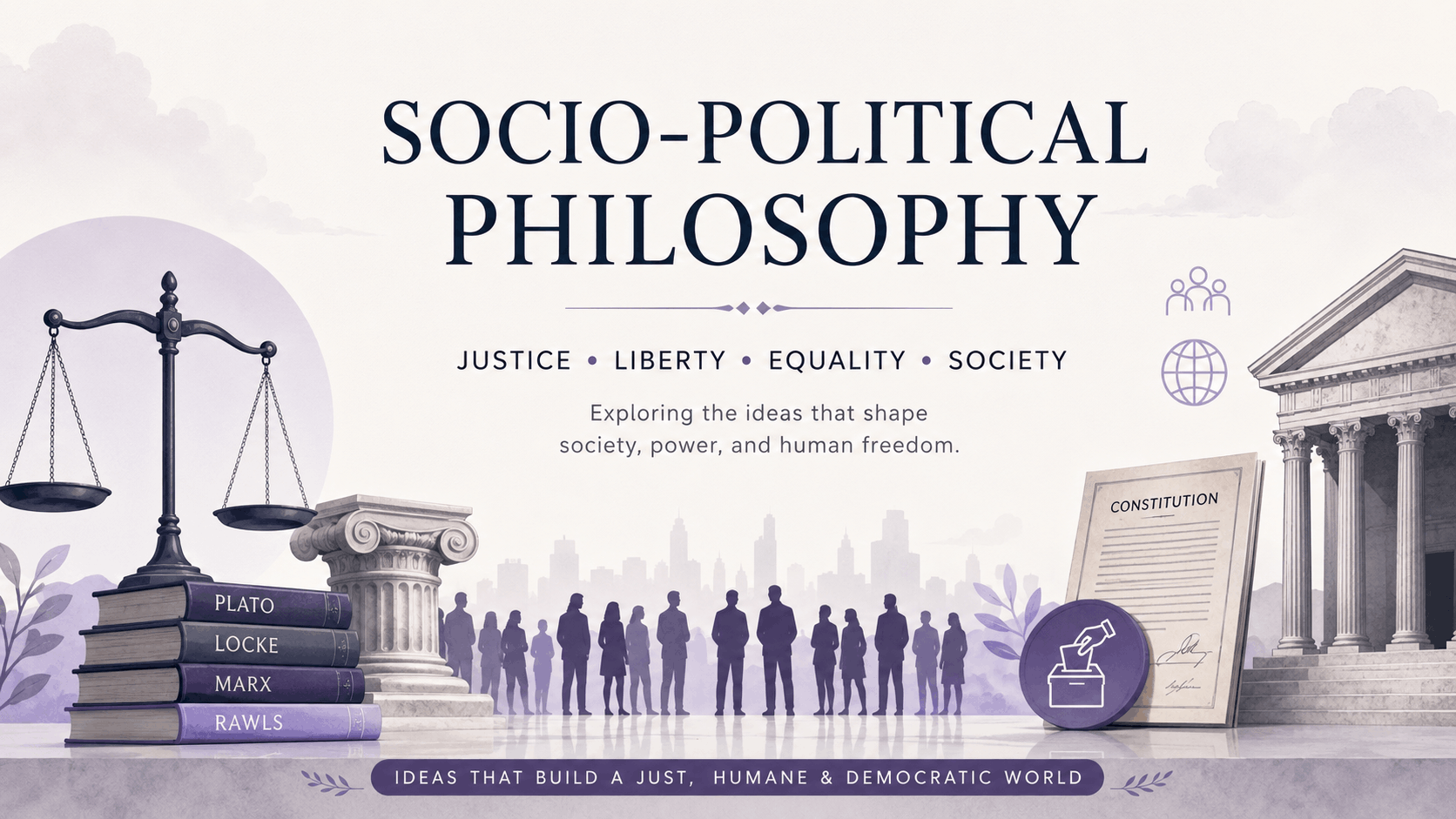
Human beings do not live in isolation. They live within families, communities, institutions, states, and political systems. Questions such as:
- Why do we need a state?
- What is justice?
- Why should citizens obey laws?
- What is freedom?
- What creates an ideal society?
These questions form the foundation of socio-political philosophy.
Socio-political philosophy is the branch of philosophy that examines the relationship between individuals and society and between citizens and political institutions. It studies the principles governing social life, power structures, political authority, rights, justice, equality, and human welfare.
For UPSC Philosophy Optional and general readers alike, this subject forms the backbone of understanding society and governance.
Historical Background
Ancient Period
Ancient civilizations raised questions regarding social order and governance.
In ancient Greece:
- Plato emphasized the ideal state governed by philosopher-kings.
- Aristotle viewed humans as political animals.
Ancient Indian thought also developed sophisticated political ideas:
- Vedic literature discussed social duties.
- Buddhist philosophy questioned hierarchy.
- Kautilya focused on statecraft.
- Dharma traditions explored social ethics.
Medieval Period
Religious institutions heavily influenced social and political thinking.
Major concerns:
- Relationship between religion and political power
- Divine authority of rulers
- Moral foundations of society
Modern Period
The modern era witnessed:
- Rise of nation-states
- Scientific revolution
- Industrialization
- Democratic movements
This period produced thinkers like Hobbes, Locke, Rousseau, Mill, and Marx.
Contemporary Era
Current socio-political philosophy addresses:
- Human rights
- Feminism
- Environmental justice
- Identity politics
- Globalization
- Digital ethics
Meaning and Definition
Socio-political philosophy can be defined as:
The philosophical study of society, political institutions, authority, justice, liberty, rights, and human relationships within collective life.
Simply stated:
Social philosophy asks:
“How should society function?”
Political philosophy asks:
“How should political power be organized?”
Together they create socio-political philosophy.
Major Concepts
Justice
Justice concerns fairness and moral distribution.
Questions include:
- What is fair?
- Who deserves resources?
- How should opportunities be distributed?
Types:
- Social justice
- Economic justice
- Political justice
Liberty
Liberty means freedom from unnecessary constraints.
Types:
Negative liberty
Freedom from interference.
Positive liberty
Freedom to realize one’s potential.
Equality
Equality examines whether individuals should receive equal opportunities and treatment.
Dimensions include:
- Political equality
- Economic equality
- Social equality
Rights
Rights protect individual interests.
Examples:
- Right to life
- Right to freedom
- Right to education
Democracy
Democracy concerns participation in governance.
Core elements:
- Representation
- Accountability
- Public participation
Political Authority
Political authority asks:
Why should citizens obey governments?
Social Contract
Social contract theories explain the origin and legitimacy of political institutions.
Major Thinkers and Their Views
Plato
Plato envisioned an ideal state ruled by philosopher-kings.
Main ideas:
- Justice as harmony
- Functional specialization
- Rule by wisdom
Aristotle
Aristotle declared:
“Man is by nature a political animal.”
He viewed the state as necessary for achieving a good life.
Thomas Hobbes
Hobbes believed the state of nature was characterized by fear and insecurity.
Key idea:
Strong authority is necessary for peace.
John Locke
Locke emphasized:
- Natural rights
- Consent of the governed
- Limited government
His ideas deeply influenced liberal democracy.
Jean-Jacques Rousseau
Rousseau introduced:
- General will
- Popular sovereignty
He believed society corrupts natural human goodness.
Karl Marx
Marx analyzed:
- Class conflict
- Economic exploitation
- Alienation
He argued political systems often reflect economic structures.
John Stuart Mill
Mill defended:
- Individual liberty
- Freedom of expression
- Utilitarian ethics
Hegel
Hegel saw history as a process of rational development.
The state represented ethical life.
Rawls
Rawls proposed:
Justice as fairness
His principles include:
- Equal basic liberties
- Fair equality of opportunity
Robert Nozick
Nozick criticized redistributive justice.
He defended:
- Individual rights
- Minimal state
Mahatma Gandhi
Gandhi emphasized:
- Nonviolence
- Decentralization
- Moral politics
B.R. Ambedkar
Ambedkar focused on:
- Social equality
- Elimination of caste oppression
- Constitutional democracy
Aurobindo
Aurobindo integrated spiritual development with social evolution.
M.N. Roy
Roy advocated:
- Radical humanism
- Individual freedom
- Rational politics
Comparative Analysis: Indian vs Western Perspectives
| Aspect | Western Philosophy | Indian Philosophy |
|---|---|---|
| Focus | Rights | Duties |
| Individual | Strong emphasis | Community emphasis |
| State | Political institution | Ethical institution |
| Justice | Legal and distributive | Dharma and social harmony |
| Freedom | Individual liberty | Spiritual liberation |
Criticisms
Socio-political philosophy faces several criticisms:
Excessive Idealism
Some theories ignore practical realities.
Cultural Bias
Many theories emerge from specific cultural contexts.
Economic Reductionism
Marxist approaches are sometimes criticized for overemphasizing economics.
Abstract Nature
Certain theories may be too theoretical for policy implementation.
Contemporary Relevance
Socio-political philosophy remains deeply relevant today.
Current examples:
Artificial Intelligence and Ethics
Questions include:
- Can algorithms be fair?
- Should AI regulate society?
Global Inequality
Economic disparities raise questions about distributive justice.
Climate Justice
Environmental responsibility is becoming a political issue.
Identity Politics
Issues concerning gender, race, and culture continue to shape politics.
Digital Freedom
Questions regarding privacy and surveillance increasingly matter.
UPSC Philosophy Optional Perspective
Important areas for preparation:
Frequently asked themes
- Justice
- Liberty
- Equality
- Democracy
- Human rights
- Marxism
- Political obligation
- Feminism
- Social contract theories
Possible PYQ Connections
Possible UPSC questions:
- Discuss Rawls’ theory of justice.
- Compare Hobbes and Locke.
- Examine Marx’s theory of class conflict.
- Explain Gandhi’s political philosophy.
- Analyze Ambedkar’s concept of social justice.
- Critically examine liberty and equality.
Conclusion
Socio-political philosophy is not merely an academic subject; it is a guide to understanding human coexistence. It seeks answers to enduring questions concerning justice, authority, freedom, rights, and social welfare.
From Plato’s ideal state to Ambedkar’s struggle for equality and Rawls’ theory of justice, socio-political philosophy continually attempts to build a more rational and humane society.
In a world experiencing technological change, political polarization, and global challenges, socio-political philosophy remains essential for thoughtful citizenship and ethical governance.
8. FAQ Section
What is socio-political philosophy?
Socio-political philosophy studies society, politics, justice, and human relationships.
Why is socio-political philosophy important?
It helps understand social institutions, governance, and ethical political systems.
Who are major socio-political philosophers?
Plato, Aristotle, Hobbes, Locke, Rousseau, Marx, Gandhi, Ambedkar, and Rawls.
What are the major concepts of socio-political philosophy?
Justice, liberty, equality, rights, democracy, and political authority.
What is social contract theory?
It explains political authority through agreements among individuals.
What is Rawls’ theory of justice?
Rawls proposed justice as fairness through equal liberties and fair opportunities.
How is Indian political philosophy different?
Indian traditions emphasize duties and ethical harmony alongside rights.
Is socio-political philosophy important for UPSC?
Yes. It forms a major portion of Philosophy Optional and helps in Ethics and GS papers.
Internal Linking Suggestions
- Plato’s Political Philosophy
- Rawls Theory of Justice
- Marxism Explained
- Gandhian Political Thought
- Ambedkar and Social Justice
- Liberty vs Equality